
Comprehensive Biography of Starscream from Transformers
Origins and Role
Starscream is typically Megatron’s second-in-command, a position he uses as a springboard for his constant schemes to take over leadership. His backstory often casts him as a scientist or high-ranking figure on Cybertron before joining the Decepticons, driven by ambition and dissatisfaction with authority. For example, in the Generation 1 (G1) cartoon, he was a scientist who lost a friend, Skyfire, and joined Megatron early in the war, as seen in the episode “War Dawn.” In newer continuities like Transformers One (2024), he starts as the leader of Cybertron’s High Guard before being defeated by D-16 (Megatron), highlighting his early leadership and eventual fall.
Personality and Abilities
Starscream’s personality is a mix of brilliance and flaw: he’s a strategic thinker but often undermined by arrogance and cowardice. He transforms into a jet, making him a top aerial combatant with weapons like null rays and missiles. In G1, his indestructible spark allows him to persist as a ghost after death, adding a unique twist to his character. This blend of traits makes him both a threat and a source of humor, especially in his frequent clashes with Megatron.
Cultural Impact
Starscream’s enduring popularity stems from his dynamic character, appearing in nearly every major Transformers continuity. His iconic voice in G1, provided by Chris Latta, and his constant betrayals have inspired memes and fan discussions. Recent fan activity, like art and toy releases (e.g., Studio Series Deluxe Transformers One Starscream in July 2025), shows his ongoing relevance.

Key Points
• Starscream is a central Decepticon character in the Transformers franchise, known for his ambition to overthrow Megatron and lead the Decepticons.
• His personality is marked by cunning, treachery, and cowardice, making him a complex and fan-favorite villain.
• He transforms into a jet, excelling in aerial combat, and has unique traits like an indestructible spark in some continuities.
• His role varies across cartoons, comics, and movies, with notable appearances in The Transformers (1984–1987), Transformers: Prime (2010–2013), and Transformers One (2024).
A Deep and Complicated Character
Origins and Background
Starscream’s origins vary across the Transformers universe, reflecting the franchise’s expansive multiverse, but a common thread is his pre-war status as a scientist, explorer, or high-ranking figure on Cybertron before aligning with the Decepticons. His ambition and dissatisfaction with authority often drive his decision to join Megatron’s faction, which seeks to overthrow the Autobots and establish Decepticon rule.
• Generation 1 (G1) Continuity:
The Architect of Friction: Why Megatron Keeps Him Close
One of the most enduring questions in the lore is why the hyper-competent, often genocidal Megatron allows Starscream to draw breath. In the G1 cartoon, it felt like a tactical oversight; in the IDW continuity, it was revealed as a profound psychological gambit. Starscream represents the “Necessary Friction.”

Megatron, for all his rhetoric about unity, understands that a revolution without an internal rival becomes stagnant. Starscream is the whetstone upon which Megatron sharpens his own authority. Every time Starscream plots, Megatron is forced to remain vigilant. In this sense, Starscream isn’t just a traitor; he is a vital organ of the Decepticon body politic. He provides the healthy dose of paranoia that keeps a military dictatorship from collapsing under its own weight.
The Tragedy of the Scientist: A Vision Corrupted
Starscream’s grip on our imagination is rooted in his origin as a man of science. In the G1 Sunbow files, his pre-war life was dedicated to the stars, not the sword. His partnership with Skyfire (Jetfire) reveals a bot who was once capable of deep, selfless friendship. When he lost Skyfire to the Arctic ice, he didn’t just lose a friend; he lost his faith in a logical, benevolent universe.
This “fallen scientist” archetype makes his villainy tragic rather than one-dimensional. Every time Starscream schemes for the throne, he isn’t just seeking power; he is trying to regain the control he lost when the polar winds took his partner. He believes that if he is in charge, he can use science and logic to “fix” the chaos of the war. His treachery is, in his own mind, a pursuit of a more efficient peace.
The IDW Shift: The Politician as the Ultimate Form
The reason Starscream “soars” in modern lore is largely due to his transformation in the IDW 2005 series. Here, the writers realized that Starscream’s true potential wasn’t as a soldier, but as a sovereign.
When the war ended and the “Non-Affiliated Indigenous Lifeforms” (NAILs) returned to Cybertron, Starscream did what Megatron and Optimus Prime could not: he adapted. He realized that the era of the fusion cannon was over. By rebranding himself as a populist leader, he tapped into a fundamental truth of the Transformers’ condition—the desire for a home that isn’t a battlefield.
His reign as the Ruler of Cybertron is the meat of his complexity. Haunted by the “Ghost of Bumblebee”—a manifestation of his burgeoning conscience—Starscream had to grapple with the reality of his own actions. He was a bot who spent millions of years wanting to be king, only to find that being a king required a level of self-sacrifice he had spent his life avoiding. This internal conflict—the “hustler” versus the “hero”—is why fans remain obsessed with him. He is the only bot who feels like he is genuinely struggling with his own nature.
Combiner Wars: The Crucible of Character
The Combiner Wars were more than a toy-line tie-in; they were the narrative crucible that forged the “Modern Starscream.” When the Enigma of Combination threatened to erase individual identity—the thing Starscream prizes above all else—he stepped up.
His alliance with Windblade was the first time we saw Starscream treat another bot as a true peer. He didn’t just tolerate her; he needed her. This era showed that Starscream’s “Good Guy” turn wasn’t a sudden change of heart, but a strategic realization: you cannot rule a graveyard. By defending Iacon and working to stabilize the Combiner plague, he proved that his love for Cybertron was real, even if it was wrapped in a layer of massive ego.
The Final Sacrifice: Redemption Through Destruction
Ultimately, Starscream’s grip on the lore was sealed by his final act in the Unicron saga. Throughout the IDW run, he was obsessed with his legacy. He wanted to be remembered. When he discovered that he wasn’t a “Chosen One” and that his life was a manipulation by Shockwave, he finally found his true freedom.
His sacrifice to destroy Unicron was the ultimate “Starscream” move. He took the Talisman, flew into the maw of the god of chaos, and gave his life. He didn’t do it because he was told to; he did it because, in his own words, “someone else might have gotten it wrong.” This is the peak of his character: an act of total selflessness driven by a total belief in his own unique importance. He died as he lived—believing he was the only one capable of saving the day.
Personality and Characteristics
Starscream’s personality is defined by ambition, cunning, and arrogance, making him a quintessential opportunist. His traits include:
• Ambition and Treachery: His defining trait is his desire to overthrow Megatron and lead the Decepticons, with schemes ranging from subtle manipulation to outright rebellion. His plots often fail due to overconfidence or Megatron’s superior strength, as seen in G1 episodes like “Traitor” (Season 1).
• Cunning and Intelligence: Starscream is a brilliant strategist, devising plans that exploit enemies’ weaknesses, but his ego frequently undermines his efforts, a recurring theme in IDW comics where he briefly rules Cybertron but fails to maintain control.
• Arrogance and Cowardice: While boastful, Starscream is quick to flee or grovel when faced with overwhelming odds, a trait evident in Transformers: Prime where he often retreats from battles.

• Charisma: Despite his flaws, his sharp wit and silver tongue make him compelling, capable of rallying Decepticons or manipulating situations, as seen in his interactions in Transformers: Animated with his clones.
This blend of villainy, incompetence, and occasional sympathy creates a dynamic character, with his constant betrayals and banter with Megatron adding humor to the Decepticons’ ranks.
Abilities and Design
Starscream’s design and abilities reflect his role as an air commander, with his primary alternate mode being a jet, often inspired by real-world fighter planes like the F-15 Eagle (G1) or F-22 Raptor (Bayverse).
• Physical and Combat Abilities:
• Alternate Mode: He transforms into a sleek, high-speed jet, granting aerial superiority, excelling in speed and maneuverability, making him a formidable opponent in the skies.
• Weapons: Equipped with arm-mounted null rays to disrupt electronics or paralyze Autobots, and cluster bombs, missiles, and a fusion cannon in some continuities, as seen in G1 and IDW comics.
• Flight: As a Seeker, a subgroup of Decepticon fliers, he’s an expert in aerial combat, capable of complex maneuvers, outpacing most Autobots.

• Durability: His resilience varies; in G1, he survives devastating injuries, while in Transformers: Prime, he’s more vulnerable but evades death through cunning.
• Unique Traits:
• Immortality (G1): In the G1 cartoon, his spark is indestructible, persisting as a ghost after death in The Transformers: The Movie (1986), causing chaos in later episodes like “Starscream’s Ghost.”
• Leadership Skills: Despite failures, he proves capable, commanding Decepticon forces effectively when Megatron is absent, as in IDW comics post-Megatron’s defeat.
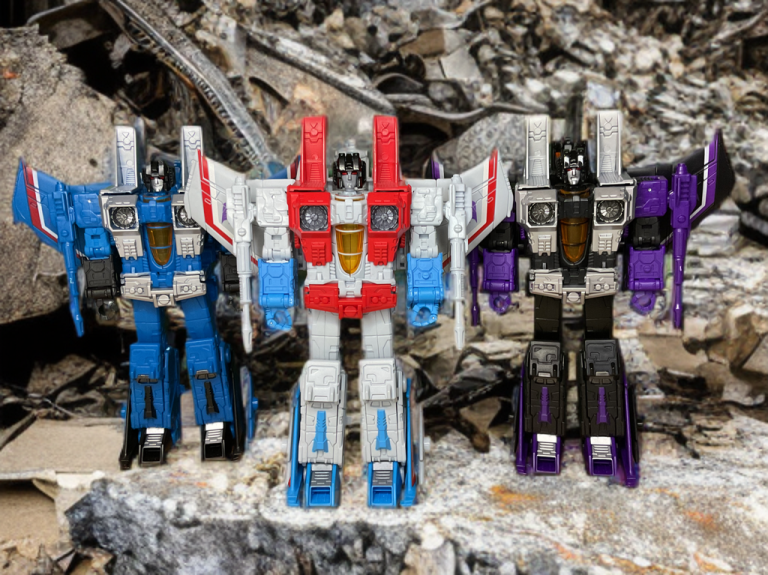
• Design: His iconic look features a red, white, and blue (or grey) color scheme in G1, with a sleek, angular jet form and humanoid robot mode with wing-like structures. Later continuities, like Transformers: Prime, give him a more menacing, insect-like design, while Bayverse portrays him as bulkier.

Role in Key Transformers Continuities
Starscream’s role varies, but he’s consistently a key Decepticon figure with leadership ambitions:
• Generation 1 (Cartoon and Comics): In G1, he’s Megatron’s second-in-command, constantly plotting, with key moments like briefly leading after Megatron’s death in The Transformers: The Movie (1986), only to be killed by Galvatron. His ghost persists, causing havoc. In Marvel comics, he gains Underbase power, becoming a near-unstoppable force before being defeated.
• Transformers: Animated: A snarky, opportunistic Decepticon, his immortality via an AllSpark fragment leads to multiple deaths and resurrections, with clones adding depth, as seen in episodes like “Transform and Roll Out.”
• Transformers: Prime: More sinister, he’s Megatron’s lieutenant, briefly a rogue agent, with moments of competence, but dies at Predaking’s hands, as shown in the series finale.
• IDW Comics: Offers a nuanced portrayal, ruling Cybertron post-Megatron, struggling with ambition and redemption, as detailed in Till All Are One.
• Transformers: Cyberverse: A classic schemer, with lighter, humorous moments, emphasizing rivalry with Shockwave, seen in episodes like “The End of the Beginning.”
• Transformers One (2024): Starts as High Guard leader, defeated by Megatron, banished, and joins the Decepticons, exploring his origins, as seen in the film’s narrative.
Starscream’s Major Multiverse Appearances
| Continuity Family | Specific Series / Media | Role & Characterization |
| Generation 1 (Original) | The Transformers (1984-1987), The Transformers: The Movie (1986) | The quintessential traitor. High-pitched, cowardly, and obsessed with replacing Megatron. Famously disintegrated by Galvatron. |
| Beast Era | Beast Wars (Episode: “Possession”) | Appears as a “mutant” spark (ghost) that possesses Waspinator to attempt a coup against Megatron (BW). |
| The Unicron Trilogy | Armada, Energon, Cybertron (2002-2005) | A more honorable, tragic warrior. In Armada, he sacrifices himself to unite the factions against Unicron. |
| Live Action (Bayverse) | Transformers (2007), Revenge of the Fallen, Dark of the Moon | An opportunistic hunter with a F-22 Raptor alt-mode. More of a sycophant/thug than a political schemer. |
| Animated | Transformers Animated (2007-2009) | A flamboyant, immortal narcissist. Uses “fragments” of the AllSpark to stay alive and creates a clone army of his own personality traits. |
| Aligned Continuity | War for Cybertron (Game), Transformers Prime, Robots in Disguise (2015) | A spindly, manipulative “sycophant” who leans heavily into the “slippery” aspect of his character. |
| IDW 2005 (The Saga Discussed) | Infiltration through Unicron (2005-2018) | The most complex version; evolves from a hustler to the legitimate Ruler of Cybertron and eventually a martyr. |
| Cyberverse | Transformers Cyberverse (2018-2021) | Starts as Seeker leader, eventually gains the power of the AllSpark and becomes a cosmic-level threat/villain. |
| Earthspark | Transformers: Earthspark (2022-Present) | A more vulnerable, sympathetic version who has been imprisoned and seeks a new purpose in a post-war world. |
| Skybound (Energon Universe) | Transformers (2023-Present Comic) | A terrifyingly competent and brutal version who seizes Decepticon leadership early by force. |
Relationships
Starscream’s relationships reflect his ambition and duplicity:
• Megatron/Galvatron: Central dynamic, a cycle of betrayal and punishment, with Megatron tolerating schemes in G1, while Galvatron is less forgiving, as in The Transformers: The Movie.
• Seekers: Leads Skywarp, Thundercracker, and others, maintaining control through fear, a recurring theme in G1 and IDW comics.
• Autobots: Occasionally allies, like with Optimus Prime in G1’s “The Burden Hardest to Bear,” but alliances are short-lived.
• Skyfire (G1): Tragic friendship, showing loyalty before ambition, as depicted in “Fire in the Sky.”
Cultural Impact and Legacy
Starscream’s enduring popularity stems from his dynamic character, appearing in nearly every continuity. His G1 voice by Chris Latta is iconic, inspiring memes and fan discussions, with recent activity like Studio Series Deluxe Transformers One Starscream toy images shared in July 2025. Fans debate his tragic nature versus selfishness, seen in X posts discussing art and moments like Megatron seeing inside his head in Transformers: Prime.
Comparative Backstory Snapshot
| Continuity | Pre-War Role | Nature of Treachery | Fate / Redemption |
| G1 Cartoon | Scientist / Explorer | Persistent & Comical | Disintegrated; becomes an immortal ghost. |
| G1 Marvel | Military Commander | Strategic & Genocidal | Destroyed by Underbase power; later rebuilt. |
| Armada | Young Warrior | Result of Abuse | True Sacrifice: Dies to save the universe. |
| Prime | Air Commander | Opportunistic / Survivalist | Survives the war; becomes a scavenger. |
| IDW 2005 | Hustler / Senator | Political & Complex | Sacrifices self to destroy Unicron. |
Notable Appearances
• Cartoons: The Transformers (1984–1987), Transformers: Animated (2007–2009), Transformers: Prime (2010–2013), Transformers: Cyberverse (2018–2021).
• Films: The Transformers: The Movie (1986), Transformers (2007), Revenge of the Fallen (2009), Dark of the Moon (2011), Transformers One (2024).
• Comics: Marvel Transformers (1984–1991), IDW Transformers (2005–2018).
• Video Games: Transformers: War for Cybertron (2010), Transformers: Fall of Cybertron (2012).
Conclusion
Ultimately, Starscream remains one of the most compelling figures in the Transformers mythos because he represents a very human flaw: the relentless, often self-destructive desire for status. While his cowardice is legendary and his treachery predictable, his resilience is undeniable. No matter how many times he is struck down by Megatron or defeated by the Autobots, Starscream always returns, fueled by the unwavering belief that he is the rightful heir to the Decepticon throne. He is more than just a lieutenant; he is the eternal spark of rebellion that ensures the Decepticon cause is never truly stable.